Separating Art Appreciation from Art History
By Kaitlin R. Murdy October 28th, 2026
Terms and methodologies help separate art history from art appreciation. But what is the difference between these two concepts? Art Appreciation is the personal opinion or feeling towards an artist’s work style. There is nothing wrong with art appreciation; it can be many people’s gateway into finding a love for art. Whether you like Van Gogh’s Starry Night or Hokusai’s The Great Wave is not what Art History is about; it's about understanding the artwork, the artists, and how they reflect the time periods and cultures they were present in. You can like or even dislike artwork, but art history is about having a deeper understanding outside of opinion.
Art History: Researching why the piece of art was made, why the style was chosen, and how that reflects on the wider society/culture of the time, aka, the historical context.
vs.
Art Appreciation: Personal opinion/feeling towards an artist’s work/style.
The Questions We Ask of Art
- How Old Is It? While numbered dates are important, much of art history places an emphasis on Art Periods and Cultural Movements. Two art periods can be happening at the same time!
- What is its Style? Style is what the art object looks like. What is it made of? What type of art object is it? Is it naturalistic? Idealized? This is where you will use many terms! Correct terms usage is required on the multiple choice, written essays, and typed research papers.
- What is its Subject? Who is being shown? What’s the story shown in the artwork? Who is that person? Real or mythological? Both? Sometimes this can be the same as the work’s history or more allegorical. This bridges the gap between Style and Context.
- Who Made it? This is part of the historical context. Sometimes we will know an artist’s name, sometimes the artist is unknown. But the “who” can also be the culture or a specific community.
- Who Paid for it? This is also part of the historical context. If we know of a specific person or organization that purchased the artwork, they are known as a patron. If the patron is unknown, or there was no patron, we can identify the artist, or culture/ community.
- Why Was it Made? Once we’ve answered all the questions above (using correct terminology and to the best of our research) we can create a full picture that tells us why an art piece was made. Is it for religious purposes? Political propaganda? A display of wealth or power? A gift? A memorial or funerary monument? Decorative? Utilitarian?
Example 1
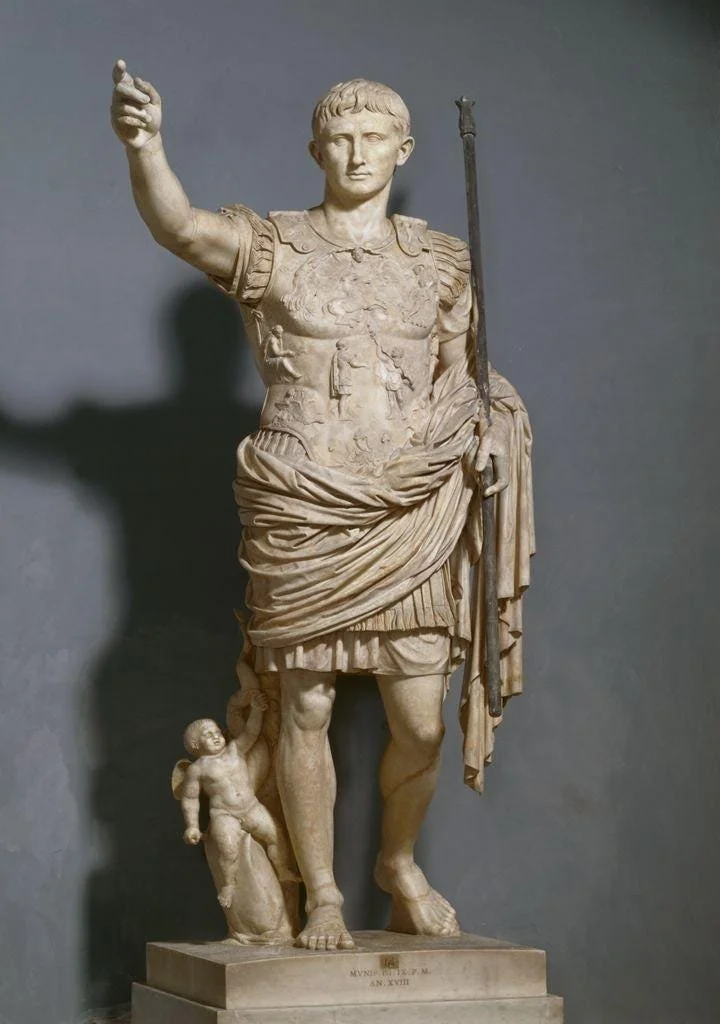
Augustus as Imperator or Augustus of Primaporta. Early 1st century CE copy of a bronze original of ca. 20 BCE. Marble, 6’ 8”. Museo Chiaramonti. Scala Archives. Artstor. https://jstor.org/stable/community.16004254.
- How Old Is It? Early Roman Empire (1st Century CE)
- What is its Style? Sculpture, Marble, Sculpture in the Round, Freestanding Sculpture, Portrait, Contrapposto, Idealized.
- What is its Subject? Augustus of Primaporta, 1st emperor of Rome, Cupid + Dolphin = descendant of Venus, Breastplate/Cuirass, maybe featuring Romans vs. Parthians, Sol and Caelus (Sun and Sky Gods), Apollo, Diana, and Tellus, personifications of conquered countries.
- Who Made it? Romans
- Who Paid for it? Livia Drusilla, Third Wife of Augustus
- Why Was it Made? Political propaganda: connection to the past, his role as a military victor, his connection to the gods, and his role as the bringer of the Roman Peace.
Example 2
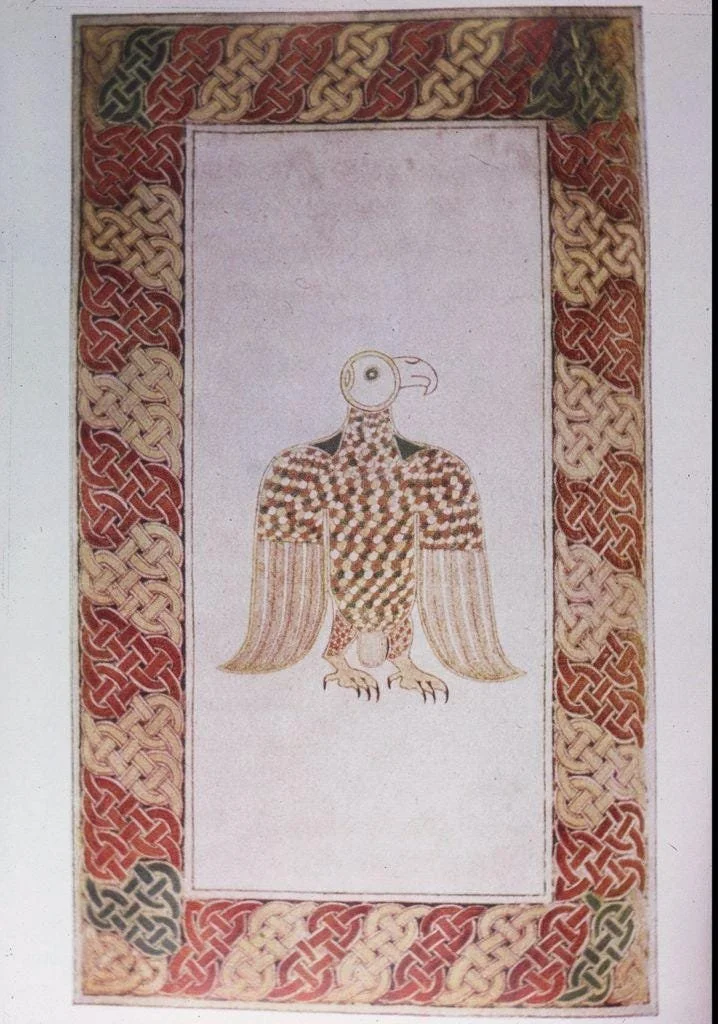
Book of Durrow Ms. A. IV. 5 Fol. 84v Symbol of Mark, the Eagle. c.680. Trinity College (Dublin, Ireland). Library. https://jstor.org/stable/community.13720179.
- How Old is it (Art Period/Movement)? Pre-Vulgate, 1,300 years old, Earliest found in Northern Europe.
- What is its Style? Illuminated Manuscript, folios, interlace, animal interlace, ornamentation, vellum, Reds/Yellows/Greens.
- What is its Subject? Gospel Book, Evangelist Page (248 folios). Evangelists are Matthew, Mark, Luke, and John. Pre-Vulgate Mark and John have switched iconography Matthew/Man or Angel, Mark/Eagle, Luke/Calf or Winged Bull, John/Lion or Winged Lion. (Vulgate Order became the more common representations: Matthew/Man or Angel, Mark/Lion or Winged Lion, Luke/Calf or Winged Bull, John/Eagle. )
- Who Made it? Columban Monks
- Who Paid for it? Columban Monastery (Unknown whether early Scottish or early Irish)
- Why Was it Made? Manuscript crafted for early Catholic/Christian worship and religion.
Remember that all of these questions are culminating into that last question: The WHY. That is the most important question for Art Historians: why was this made? Someone spent time, money, resources, labor, and more to conceptualize and create this thing.
Identifying questions such as these help organize your research and understanding so that the information does not become overwhelming in its scope. Students of Art History often start with these basic questions and then expand on them for deeper meaning as they become more comfortable with research and their own writing.
Speaking of writing, lets discuss a few other beginners tools: Methods and Terminology
Methods
There are two primary methods that I usually start my students with: the methodology of Iconography and the methodology of formalism and context. Formalism and context can also be utilized in tandem with iconography in smaller essays. Let’s begin with Formalism and context:
Formalism and Context
This method follows the simplified idea that Style and Context create Meaning. The questions art historians ask are where we begin; once we’ve gathered that information, it is organized into style, context, and meaning for expansion. Looking something like this:
-Style: What is its Style? What is its Subject? How Old is it (Art Period/Movement)?
-Context: Who made it? Who paid for it? How Old is it?
- Meaning: Why was it made?
This is the most simplistic version of this structure for ease of understanding. Let’s use Example 2 from above. If we took the information from the manuscript page and applied it to this methodology it would look something like this:
-Style:
What is its Style? Illuminated Manuscript, folios, interlace, animal interlace, ornamentation, vellum, Reds/Yellows/Greens.
What is its Subject? Gospel Book, Evangelist Page (248 folios). Evangelists are Matthew, Mark, Luke, and John. Vulgate Order: Matthew/Man or Angel, Mark/Lion or Winged Lion, Luke/Calf or Winged Bull, John/Eagle.
How Old is it (Art Period/Movement)? Pre-Vulgate, 1,300 years old, Earliest found in Northern Europe.
-Context:
Who Made it? Columban Monks
Who Paid for it? Columban Monastery (Unknown whether early Scottish or early Irish)
How Old is it? PreVulgate, 1,300 years old, Earliest found in Northern Europe
- Meaning:
Why was it made? Manuscript crafted for early Catholic/Christian worship and religion.
Once that information has been organized and established in the structure of formalism and context, then it can be put in proper sentences, terminology applied, and further expanded on in more detail. Often the area that requires further expansion is context, as those questions get us to the base ideas of the history of the object, but we will need to present more specific concepts that usually relate to the Meaning aka the Why.
Let’s move forward to the secondary methodology:
Iconography
Iconography can be a methodology used alone or in tandem with other methods like formalism and context. It involves reading and interpreting signs and symbols in works of art, based on historical context and cultural interpretations. More simply, many things depicted in Art are not literal; they are chosen to represent concepts, ideas, values, and more. You have probably used something similar in your school days of literature studies; the blue curtains aren't simply blue curtains, but carry deeper meaning or symbolism.
Let’s use an example:
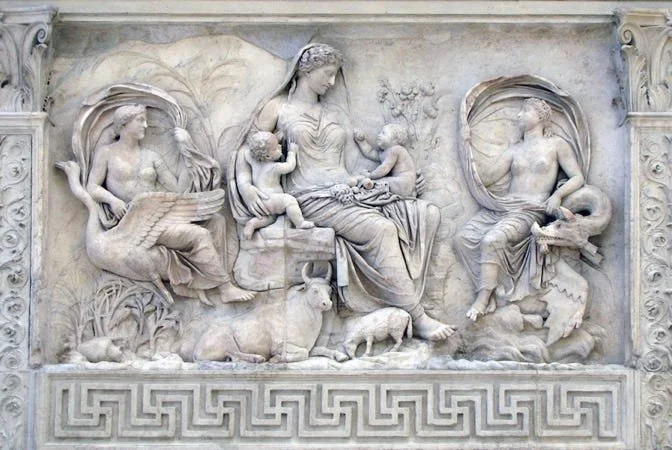
Ara Pacis Augustae (Female Personification), 9 BCE, Early Empire, Rome
What can we see visually in Ara Pacis Augustae?
A woman sitting on a swan
A large woman in the center
Two babies on the woman in the center’s lap
A woman riding a dragon-like beast
Various plants and farm animals, like a bull and a lamb.
Ok, we can recognize all these elements of the subject depicted, but to give an art-historical analysis, we need to dig deeper into the subject; we need to discuss the iconography. Everything depicted in this sculptural relief represents something important to the Early Empire of Rome.
A woman sitting on a swan- the swan is a symbol of the goddess Venus, who is the patron goddess of Rome. Thus, it is most likely that this is depicting Venus. However, she has also been interpreted as the Winds that aid in harvest or with her placement over a relief of plant life, the land itself.
A large woman in the center- the most accepted concept is that she represents Tellus Mater, aka Mother Earth. However, like the other female figures in this piece, there have also been other interpretations of her, such as Italia (Italy), Pax (Peace), or Venus.
Two babies on the woman in the center’s lap- most likely a representation of Romulus and Remus, the claimed founders of Rome. They can also represent the happiness and safety of Rome's children.
A woman riding a dragon-like beast- This figure could represent Italia, as dragons have often been used to symbolize Italy or Rome. She could be a secondary wind in tandem with our woman riding the swan, the pair representing Northern and Southern Winds. With her placement over the relief of waves, she could also be the sea, a complement to the personification of the land with the woman on the swan.
Various plants and farm animals, like a bull and a lamb- these most simply are representations of prosperity. Having animals and plants that would have been used for food appearing in abundance suggests agricultural success and fertility.
As one can see, all of these figures were carefully designed to portray the ideals of the piece. While today we have to theorize on the exact interpretation of these figures, during the era Ara Pacis Augustae was displayed, the culture viewing it would have understood the symbolism portrayed.
An iconographic reading like this can be utilized in tandem with the Formalism and Context Methodology, particularly in an in depth analysis of Subject:
Style:
What is its Style? Life-size relief sculpture on an alter, mixture of high and low relief, displays classical calm and idealized figures, drapery is carefully detailed, it is meticulously balanced, symmetrical and stable.
What is its Subject? The woman on the left: the swan is a symbol of the goddess Venus, who is the patron goddess of Rome. Thus, it is most likely that this is depicting Venus. However, she has also been interpreted as the Winds that aid in harvest or with her placement over a relief of plant life, the land itself. Woman in the Center: the most accepted concept is that she represents Tellus Mater, aka Mother Earth. However, like the other female figures in this piece, there have also been other interpretations of her, such as Italia (Italy), Pax (Peace), or Venus. The Babies: most likely a representation of Romulus and Remus, the claimed founders of Rome. They can also represent the happiness and safety of Rome’s children. Woman on the Right: This figure could represent Italia, as dragons have often been used to symbolize Italy or Rome. She could be a secondary wind in tandem with our woman riding the swan, the pair representing Northern and Southern Winds. With her placement over the relief of waves, she could also be the sea, a complement to the personification of the land with the woman on the swan. Various plants and farm animals, like a bull and a lamb, most simply are representations of prosperity. Having animals and plants that would have been used for food appearing in abundance suggests agricultural success and fertility.
How Old is it (Art Period/Movement)? 9 BCE Early Empire Rome
-Context: The historical context of this celebrates the fertility of “New Rome”. This “New Rome” is ushered in by Augustus, and particularly with his victory over the rebellions in France and Spain. This victory brought forth a 200 years of peace in the Roman perspective, also known as Pax Romana. This relief celebrates Augustus’s victory and rule. With the inclusion of the figures of Romulus and Remus, it creates a direct connection between Augustus and the mythic founders of Rome.
Who Made it? Unnamed Roman sculptures (possibly with the aid of slaves?)
Who Paid for it? Emperor Augustus
How Old is it? 9 BCE Early Empire Rome.
- Meaning: This relief expresses the stability and bounty of the New Empire of Rome, while also legitimizing Augustus’s rule as the literal and symbolic rebuilder of Rome.
The usage of terminology and methodology are two elements that separate Art History from Art Appreciation. By using specific methods and terms, discussion of art changes from opinions based on personal aesthetics to an analysis of art in a specific time period and culture. By viewing art from this more curious perspective, individuals can garner a deeper understanding of art and history beyond a simplistic “like” or “dislike”.